Tokens and pricing, explained simply
What "$2 per million tokens" on an AI price list means, and how to estimate what your own usage would cost.
8 minAs of Oct 2026
By the end of this guide
- Explain what tokens are and why they don't match character counts.
- Roughly work out what your usage costs from input and output token prices.
- Understand why long conversations burn through money and usage limits faster.
Who this is for
- Anyone for whom AI price lists don't quite add up
- Anyone who needs a rough cost estimate before adopting an AI API
What you need
- Reading "What is an LLM?" first will help.
- A spreadsheet or calculator for the sums (optional)
Key ideas
Tokens are pieces of text
LLMs read text not as letters or words but as pieces called tokens. A common word may be a single token; a rare one gets split into several.
How text is split varies by model. The same content often takes more tokens in Korean than in English, so leave some headroom when you estimate costs and limits.
The same sentence split into pieces (illustration only — real splits differ by model) Sentence Pieces (example) Pieces AI Ping은 매일 아침 소식을 전합니다 AI | Ping | 은 | 매일 | 아침 | 소식 | 을 | 전 | 합니다 9 AI Ping sends the news every morning AI | Ping | sends | the | news | every | morning 7 Input and output are priced separately
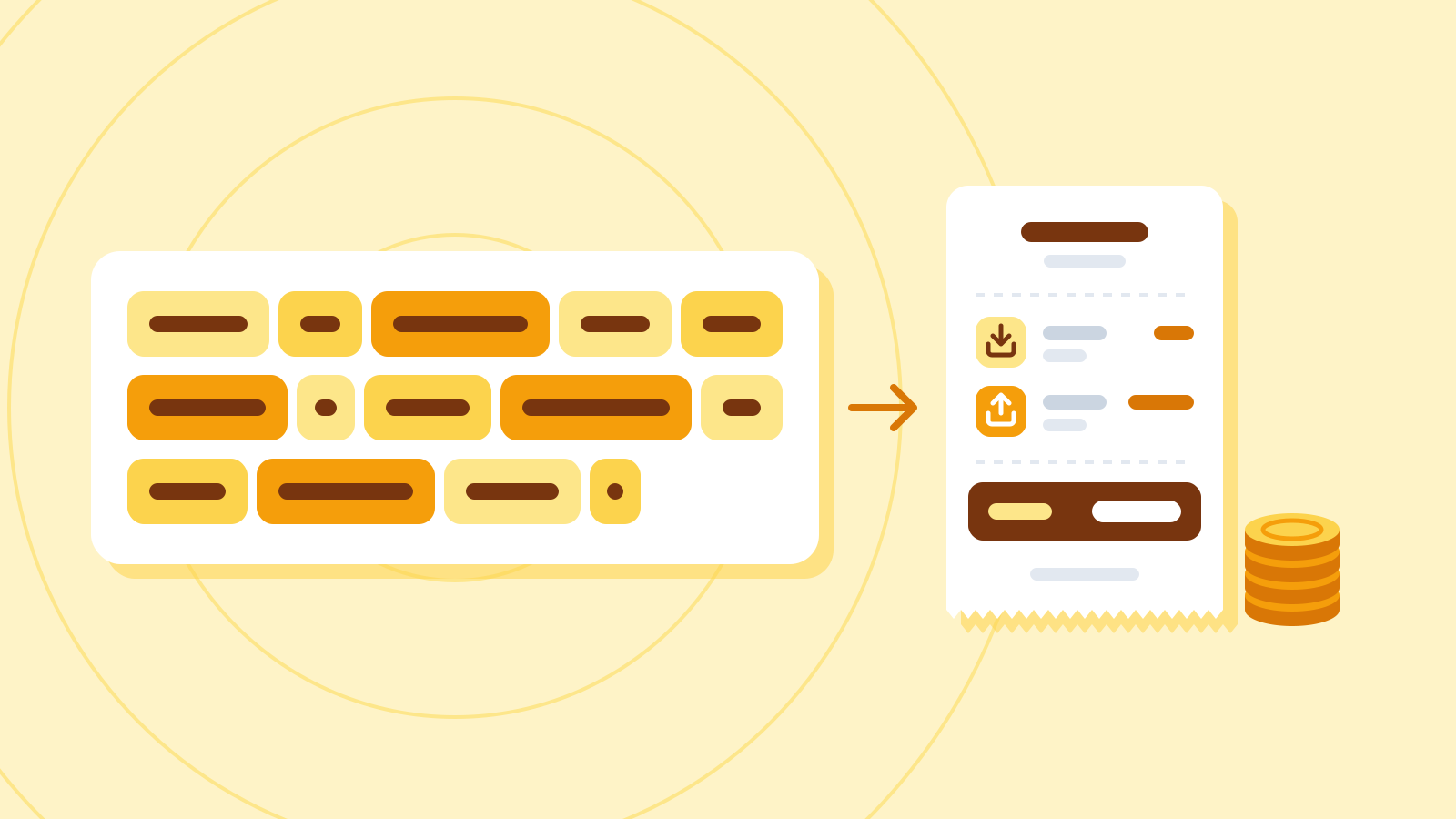
API prices are usually quoted per million tokens, with what you send (input) and what the model writes (output) priced separately. Output often costs more than input.
Say a model charges $2 per million input tokens and $10 per million output tokens, and one request uses 2,000 input and 500 output tokens. The sum looks like this:
Cost of one request (example prices: $2 input, $10 output per million tokens) Item Tokens Sum Cost Input 2,000 2,000 ÷ 1,000,000 × $2 $0.004 Output 500 500 ÷ 1,000,000 × $10 $0.005 Total 2,500 $0.009 Check it
- Run that request 1,000 times a day and it's $9 a day, or about $270 over 30 days.
- Prices vary by model and change over time — use the current price list for the model you plan to use.
Long conversations keep growing the input
A chat assistant rereads the earlier conversation every time it answers. So the longer the chat, the more input tokens each turn uses — which means higher bills on an API, and on a subscription with usage limits, hitting the limit sooner.
Some APIs bill a repeated opening part at a discount (prompt caching), but the amount processed still grows with every turn.
Start a new conversation when the topic changes, and paste only the parts of long documents you need. It helps both cost and accuracy.
Input processed each turn when every question is 300 tokens and every answer 500 (example) Turn Input processed this turn 1st 300 2nd 1,100 3rd 1,900 4th 2,700 5th 3,500 Total 9,500 Check it
- Asked as five separate questions, the input would be 1,500 tokens in total. Strung together in one chat, it's more than six times that.
Subscription or API?
Subscriptions for chatting in an app are usually a flat monthly fee with usage limits; with an API you pay per token for what you use.
For automated, repeated jobs an API usually fits; for people chatting directly, a subscription is usually simpler. Either way, estimate a month of usage first.
Example prompt My team wants AI to sort 200 customer messages a day. Each message averages 300 tokens and each result about 50 tokens. For a model at $2 per million input tokens and $10 per million output tokens, roughly what would 30 days cost? Show your working.
Example AI reply Daily input: 200 × 300 = 60,000 tokens → 60,000 ÷ 1,000,000 × $2 = $0.12
Daily output: 200 × 50 = 10,000 tokens → 10,000 ÷ 1,000,000 × $10 = $0.10
About $0.22 a day, or roughly $6.60 for 30 days. Sending your sorting rules or examples with every request adds input tokens, so budget with some margin.
Check it
- Double-check the assistant's arithmetic with a spreadsheet or calculator.
- The most accurate figure comes from the provider's usage page after a few days of real use.
Common mistakes
- Treating character counts as token counts
- Looking only at the input price and forgetting output
- Carrying on in one long chat after the topic has changed
References
- Language Model Tokenizers Introduce Unfairness Between Languages — arXiv (Petrov et al., 2023)
- Pricing — Claude Platform Docs (Anthropic)
- Context windows — Claude Platform Docs (Anthropic)
- Understand and count tokens — Google AI for Developers