How many packs should you order? Checking stock records with AI
Turn a stock count, delivery note and delay notice into an order draft. Convert packs to pieces, exclude late stock and check the method on a second item.
24 min readAs of Nov 2026
Lesson guide · goals & preparation
By the end of this lesson
- Convert inputs to one unit before asking for an order.
- Revise only the affected delivery and write a fresh purchase note.
Who this is for
- People who count stock or receive deliveries in a small shop
What you need
- A pencil is enough. All quantities and times are fictional.
1 / 4
Theory
Understand what to ask AI to do, how to ask, and the ideas behind the workflow.
Start with the cups you need on the shelf
On Friday afternoon a café is preparing cups for a Saturday event. Two wrapped stacks sit beside loose cups. A supplier message also says “two”. The word tells you little until you know whether those units are packs, pieces or deliveries.
The fictional target is 58 usable cups by Saturday at 09:00. It already includes a reserve. Adding another buffer would count it twice. If the source had only given a guest count, you would first need cups per guest.
Ask the assistant to reconcile records and show arithmetic. Staff still check the shelf and arrange collection. For this example the supplier has confirmed extra packs can be collected at 08:00.
Read three records in pieces
A shelf count describes what is physically present. A delivery note describes a future movement. D7 has not been received, so it is separate from the shelf count.
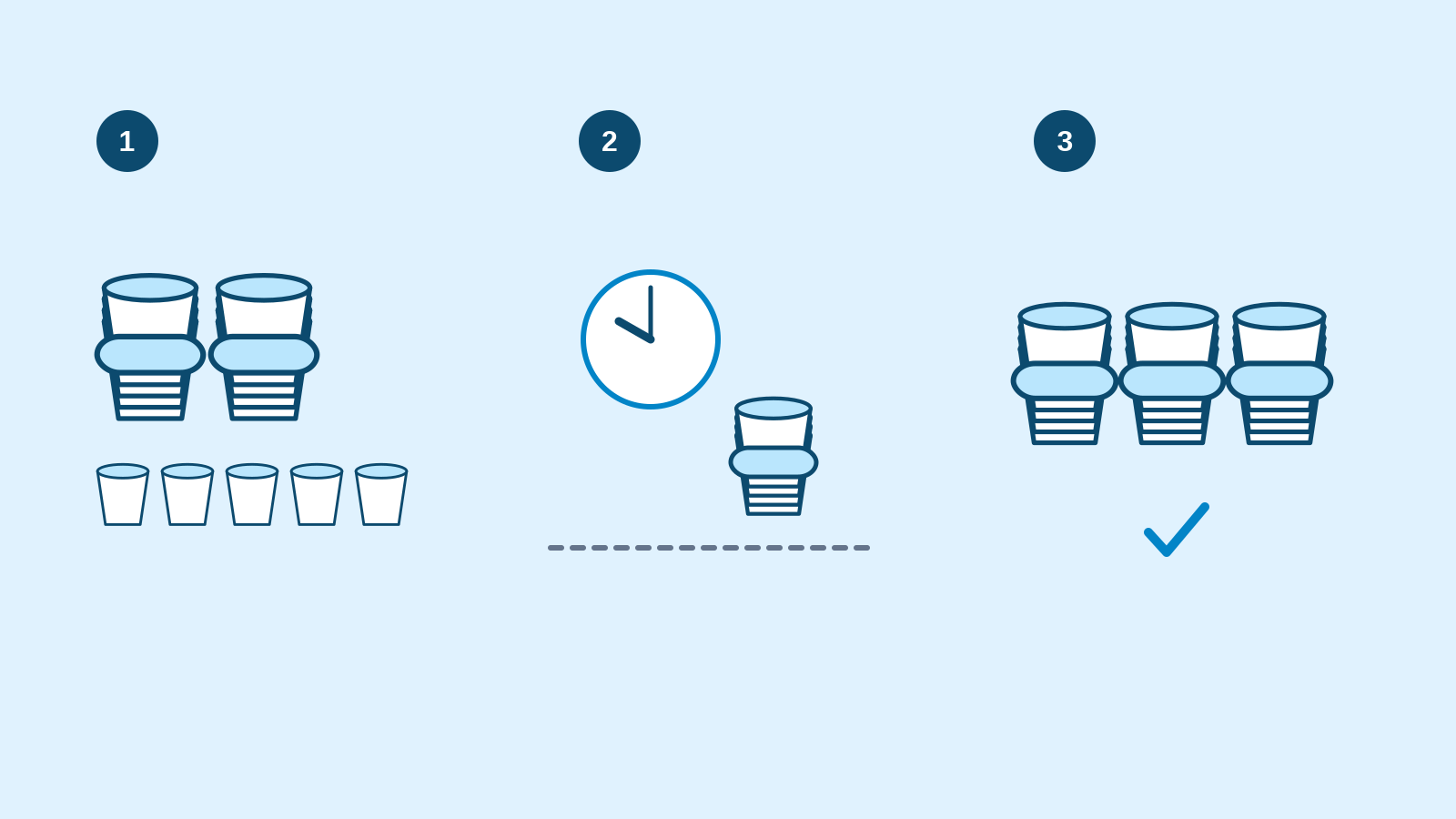
Illustration: Count wrapped stacks and loose cups, set aside the late delivery, then fill the gap with whole packs · AI Ping
- Two packs contain 24 cups. Add five loose cups for 29 on hand.
- D7 now arrives at 10:00, too late for the 09:00 event. Keep its receipt pending.
- The gap to 58 is 29. Three more packs of twelve bring the total to 65.
Read every step as text
- The shelf holds 2 sealed packs and 5 loose cups. Adding 2 and 5 gives 7, but packs and cups are different units. The question: how many more packs for 58 cups by Saturday 09:00?
- P1 says a pack holds 12. Two sealed packs come to 2 × 12 = 24 cups.
- Add the five loose cups: 29 on hand. This is what was actually counted on the shelf.
- T1 sets the target at 58 by Saturday 09:00, reserve already included. 58 − 29 leaves a shortfall of 29.
- D7’s two packs, 24 cups, now arrive at 10:00. That is after the 09:00 event, so they are not added. The delivery is late, not cancelled; it stays on record to be logged on arrival.
- Convert the 29 into packs. Two packs give 24, five short, and packs are sold whole. Three are needed.
- Extra packs under C1 can be picked up at 08:00, before the event. Three packs add 36: 29 + 36 = 65.
- Sixty-five is seven over the target of 58, while two packs would have reached only 53. Three is the minimum. This remains a draft order awaiting approval.
Convert stock into the smallest unit you actually use. Two packs of twelve plus five loose cups give 29 cups. Keep that line in front of you while reading the draft.
An identifier lets you trace an amendment to the original delivery. A second message about D7 does not create another order. A pack size also belongs to its item. A lid may come in a different pack.
Cup C records at 16:00 on Friday Record Details S1 count 2 sealed packs + 5 loose cups P1 pack 12 cups per pack, sold in whole packs D7 due 2 packs due Sat 07:30, not yet received T1 event 58 by Sat 09:00, reserve included C1 pickup Extra packs available for Sat 08:00 pickup
2 / 4
Step by step
Learn what to prepare, how to request help and how to revise the result through examples and explanations.
Make the first request show its work
Ask for four columns before asking for the final quantity. A line for current stock, eligible deliveries, shortage and packs exposes any unit mismatch.
On the original timetable, 29 on hand plus 24 due makes 53. Five more cups are needed. Rounding up five divided by twelve gives one extra pack. Keep the intermediate numbers in pieces.
The handoff should still say “29 on hand, 24 expected”. Writing “we have 53” loses the dependency on tomorrow’s delivery.
Example prompt Use S1, P1, D7, T1 and C1 to draft an order for Sat 09:00. Show on hand → due in time → missing pieces → whole packs. Give each input its unit and record ID. Do not place an order or confirm receipt. Source records S1 count | 2 sealed packs + 5 loose cups P1 pack | 12 cups per pack, sold in whole packs D7 due | 2 packs due Sat 07:30, not yet received T1 event | 58 by Sat 09:00, reserve included C1 pickup | Extra packs available for Sat 08:00 pickup
Find the one line changed by a delay
D7 moves to Saturday 10:00. It remains a real delivery, but the café cannot serve the 09:00 event with those cups. Preserve it in a later-arrivals column.
Here is an editor-written faulty draft to review. “D7 is already ordered, so keep its two packs. Buy one more pack for the five missing cups.” The unsupported step is treating an order as available before the deadline.
Amend only the arrival time. Keep the shelf count, target, pack size and extra collection slot fixed. Ask the assistant to point out which lines of its first calculation now change.
Example prompt M2 says “D7 now arrives Sat 10:00.” Replace the time on that one delivery. Preserve S1, P1, T1 and C1. Split arrivals before and after 09:00, recompute missing pieces, additional packs and surplus at the deadline.
Check the revised order backwards
The revised shortage is 29 cups. Three extra packs contain 36. At 09:00 there would be 65 cups, seven over the target. D7 contributes zero to that total.

Illustration: A timeline separates three pickup packs before the deadline from two packs arriving afterwards · AI Ping Check minimality by removing one pack. With two extra packs you would have only 53 cups. Three cover the event and two do not.
Keep the 08:00 pickup action separate from the 10:00 receipt. A completed worksheet is still a draft until a person confirms the purchase.
Revised purchase note for the next shift When Quantity and action Sat 08:00 Request pickup of 3 extra packs under C1. Await approval Sat 09:00 29 + 3×12 = 65. Target 58, surplus 7 Sat 10:00 Log D7’s 24 cups only after delivery
3 / 4
Self-check
Think about what you would ask AI, then read the explanation. Written submissions and external AI use are optional.
This is a learning check, not a test you must pass. Use the explanations to understand the ideas.
Q1The pack size is missing. What should you ask?
Write your thoughts (optional)
Your writing is not sent anywhere. It disappears when you leave or reload this page, so copy anything you want to keep.
Read the answer and explanation
Ask how many pieces a sealed pack of C contains. A pack count alone cannot establish the piece count.
This is your own review, not an automatic score.
Q2Should you delete D7 from the delivery book?
Write your thoughts (optional)
Your writing is not sent anywhere. It disappears when you leave or reload this page, so copy anything you want to keep.
Read the answer and explanation
Exclude D7 from the morning calculation and keep its delivery record for receipt. The times are fictional.
This is your own review, not an automatic score.
Q3What are the original and revised Sunday lid orders and surpluses?
Write your thoughts (optional)
Your writing is not sent anywhere. It disappears when you leave or reload this page, so copy anything you want to keep.
Read the answer and explanation
In this fictional case there are 19 on hand. Before the delay the gap is 14, so order two packs and finish with two spare. Afterward the gap is 22, so order three with two spare. Two would yield only 35. Record L2 separately for noon.
This is your own review, not an automatic score.
Common mistakes
- Adding pack counts directly to loose pieces
- Recording a late delivery as cancelled
Your learning record
Completion is optional. Mark this lesson when you feel ready, or move to the next lesson without marking it.
Completion is saved in this browser.
4 / 4
Apply to your work
Consider how new material changes the workflow and checking criteria. Trying an external AI tool is optional.
Try it: order lids for Sunday
Start a blank sheet with these lid records. Mark the pack size and deadline before copying any previous formula. The cup pack size does not carry over.
Produce one order before and one after the amendment. Name the changed source, test one fewer pack, then open the Sunday lids answer under the review questions.
Fresh records · 41 lids needed by Sun 11:00 Record Observation L1 8 per pack, on hand 2 packs and 3 loose L2 1 pack originally due Sun 10:00 L3 L2 now due Sun 12:00 L4 Extra whole packs available for Sun 10:30 pickup
Write a note (optional)
Use this only if you want to record a prompt or your understanding. This is a notebook, not a connected AI assistant.
Your writing is not sent anywhere. It disappears when you leave or reload this page, so copy anything you want to keep.
References
- ROUNDUP — Google Docs Editors Help
- Checking a pickup book — AI Ping