OLED iPad mini splits AI hardware by storage, with dual engines at 512GB
3-line summary
- A20 Pro CPU and Neural Engine configurations vary by storage capacity.
- U.S. Wi-Fi pricing starts at $699, with 512GB at $999.
- Siri AI carries operating-system, language and usage conditions.

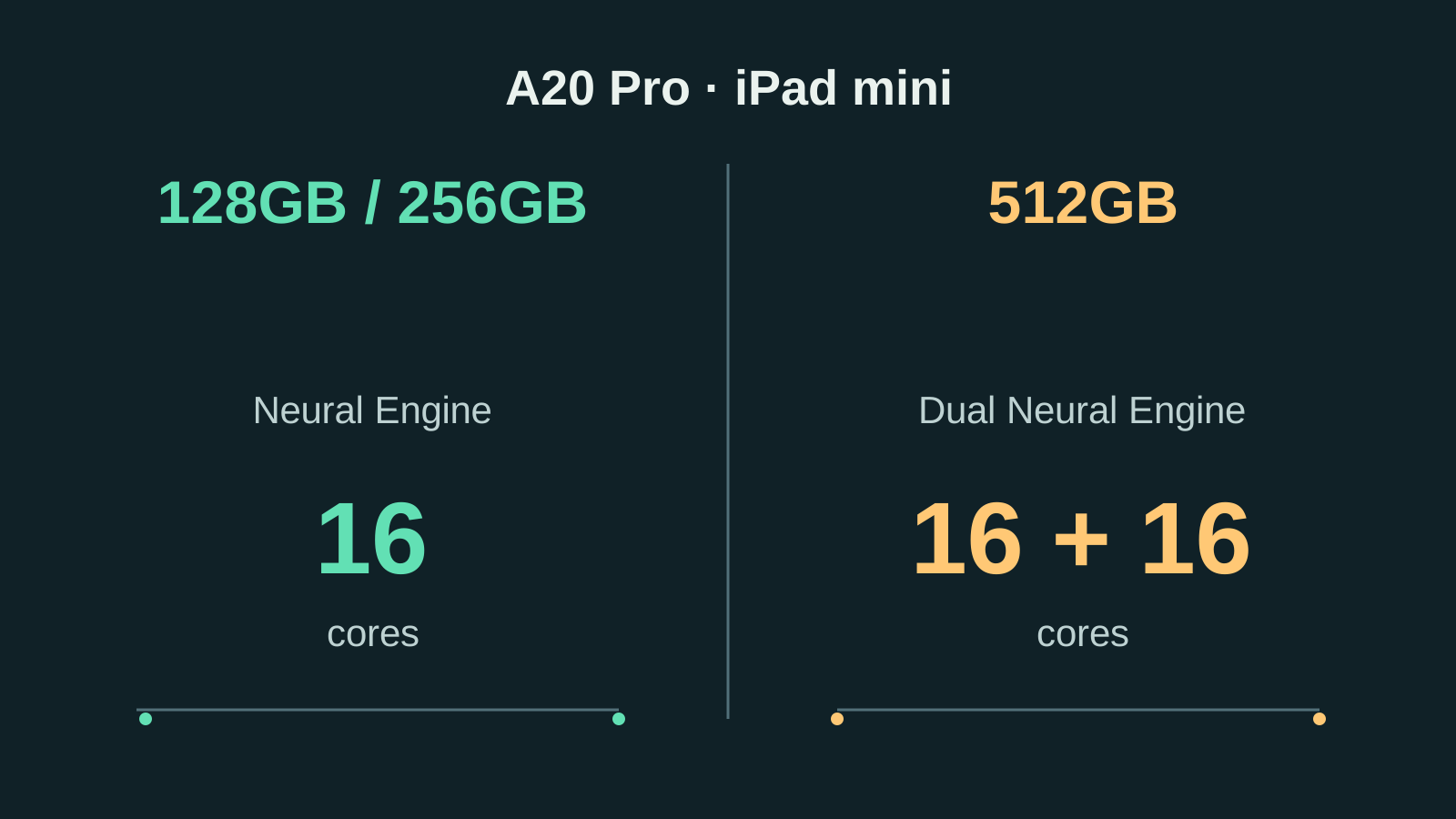
Apple announced an OLED iPad mini with A20 Pro on October 26. The 512GB model receives a Dual 16-core Neural Engine, making storage capacity part of the AI hardware choice.
Buyers now choose compute hardware alongside storage space. Apple’s U.S. store lists standard-glass Wi-Fi models at $699 for 128GB, $799 for 256GB and $999 for 512GB. Moving from the entry configuration to the dual-engine model costs $300.
Specifications give 128GB and 256GB five CPU cores and a 16-core Neural Engine. The 512GB version has six CPU cores. Super cores number two throughout, with three or four efficiency cores. Seven GPU cores and GPU Neural Accelerators are common.
The preceding A17 Pro mini, introduced in 2024, also offered 128GB, 256GB and 512GB. Its published specifications listed one chip configuration: six CPU cores, five GPU cores and a 16-core Neural Engine. Its 8.3-inch IPS LCD was rated at 500 nits. Storage now carries an additional chip distinction.
Apple’s claim of up to 4.5 times faster LLM processing has specific conditions. A September test compared preproduction hardware with production A17 Pro units using Locally AI 1.65.0, a four-billion-parameter model and a 1,000-token prompt. The footnote measures time to first token, not the speed of every generative task.
The OLED display grows to 8.5 inches. Specifications distinguish 600-nit maximum full-screen brightness from a 1,200-nit peak for HDR content; minimum brightness is one nit. Optional nano-texture glass is offered on the 256GB and 512GB versions.
U.S. Wi-Fi nano-texture configurations cost $899 at 256GB and $1,099 at 512GB, a $100 premium over standard glass. The 256GB option retains its five-core CPU.
AI eligibility and where requests run
Apple Intelligence’s compatibility list includes iPad mini models from A17 Pro onward. The new mini’s AI eligibility therefore extends across capacities. Apple describes Siri AI searching personal photos, email and notes, and taking actions in apps. Its current feature page identifies English availability.
Apple combines on-device processing with larger server-based models through Private Cloud Compute. It says data used for those server requests is never stored or made accessible to Apple. Neural Engine core counts alone do not establish where every AI request runs.

Developers also select the model path. Apple’s development documentation describes Foundation Models access to on-device and Private Cloud Compute models, alongside external providers implementing its model interface. App Intents connects an app’s content and actions to Siri. An app’s adopted models and features determine how it uses the hardware.
The new mini’s announcement footnote specifies iPadOS 27.2 beta and a supported language for Siri AI. Server-backed features face daily usage limits varying with request complexity and demand. Apple plans paid expanded access; this announcement specifies no fee.
Korean starting prices are 1,149,000 won for Wi-Fi and 1,399,000 won for cellular. Apple announced October 28 preorders in 36 markets including the United States, with deliveries and store availability beginning November 6 in selected markets. The statement leaves Korea’s specific on-sale date unconfirmed.
Sources
- Launch — Apple
- KR pricing — Apple Korea
- A20 Pro iPad mini specifications — Apple
- U.S. storage and glass configurations — Apple
- A17 Pro predecessor specifications — Apple
- Performance claims and testing footnotes — Apple
- AI compatibility and processing — Apple
- Developer model access — Apple