M6 MacBook Pro brings faster local AI, with preorders opening October 28
3-line summary
- Apple announced M6 MacBook Pro and iMac models for October 28 preorders and November 6 availability.
- The laptop’s claimed 1.3× first-token improvement compares specific M6 and M5 test systems.
- Memory bandwidth and iMac expansion ceilings depend on the selected configuration.

Apple introduced an M6-powered 14-inch MacBook Pro and iMac on October 27, expanding its lineup for running AI workloads directly on a personal computer. Preorders open October 28, with deliveries and store availability beginning November 6. For the laptop, Apple reports up to 1.3 times the first-token performance of the M5 model in a local language-model test.
The announcement brings an existing chip to two more computer designs. M6 first appeared with the Mac mini announcement on August 25. It now powers the base 14-inch MacBook Pro, while the higher-performance 14-inch and 16-inch options retain M5 Pro and M5 Max. The generation number alone does not rank every chip in the current laptop lineup.
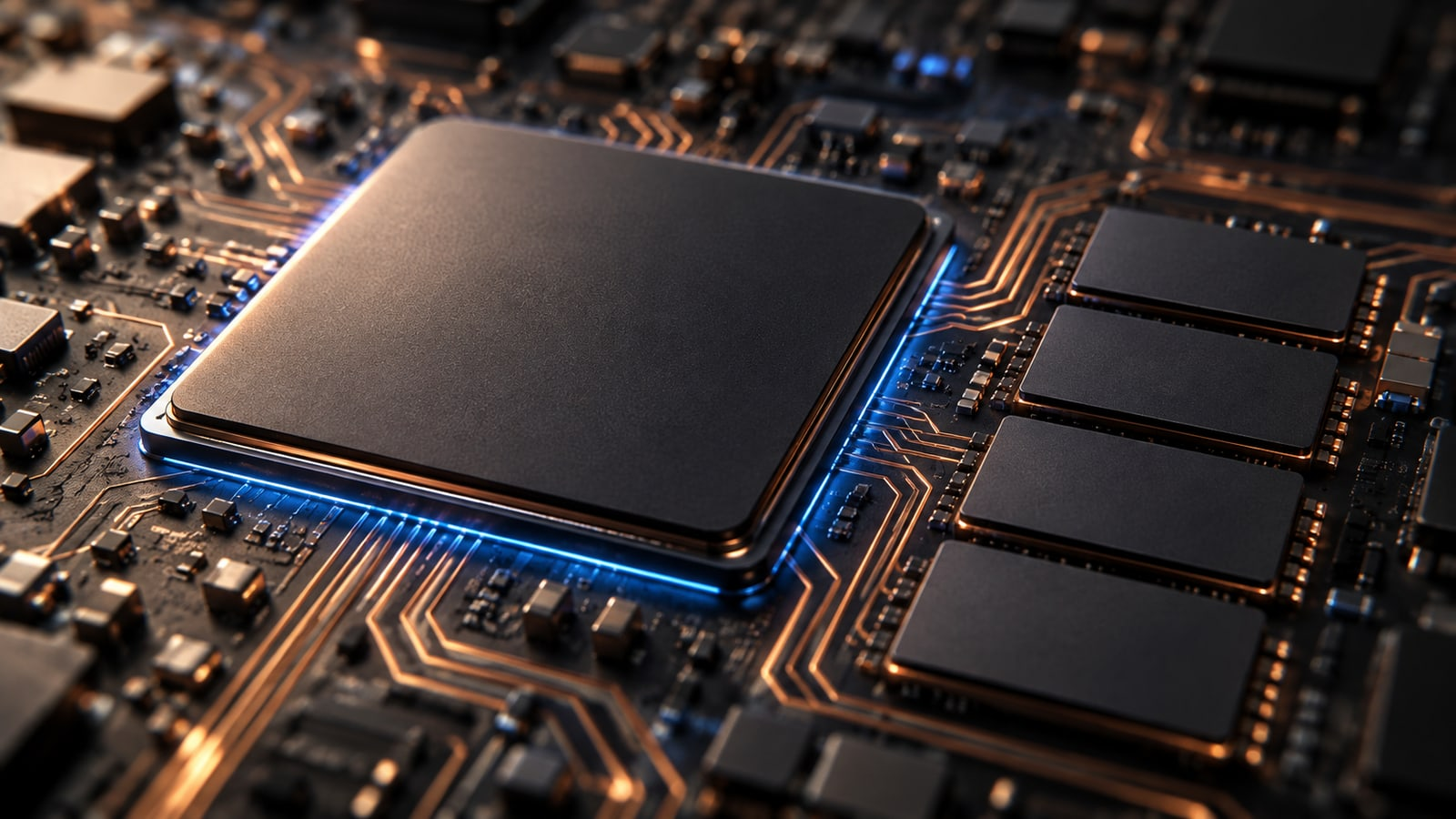
M6 uses a 2-nanometer process and includes a Neural Accelerator in each GPU core. Apple describes those accelerators as supporting workloads such as local language-model prompt processing and image generation. Two separate 16-core Neural Engines handle on-device AI computation. The MacBook Pro configuration has a 12-core CPU and a 12-core GPU.
Apple reports up to 13 times the first-token performance of the 13-inch M1 MacBook Pro and up to 1.3 times that of the 14-inch M5 model. This measures the wait before an answer begins, not its full generation speed or correctness.
Apple ran the test in September using LM Studio, a 14-billion-parameter model with 4-bit quantization, and a 16,000-token prompt. The preproduction M6 and production M5 systems each had 32GB of memory and a 4TB SSD. The production M1 comparison machine had 16GB and a 2TB SSD.
Memory choices change the M6 specifications
The MacBook Pro starts with 16GB of unified memory, with 24GB and 32GB options. Its specification sheet assigns 153GB/s of memory bandwidth to the 16GB version and 170GB/s to the larger configurations. The advertised maximum therefore depends on the memory tier. Storage starts at 1TB, with 2TB and 4TB options.
The iMac has two M6 configurations. The version with a 10-core CPU and 10-core GPU supports up to 24GB of memory; the 12-core CPU and GPU version supports up to 32GB. Both start with 16GB and a 256GB SSD. Their storage ceilings are 1TB and 2TB respectively, alongside a 24-inch 4.5K Retina display. The 10-core CPU combines two super cores, three performance cores and five efficiency cores. The 12-core version keeps two super cores, with four performance and six efficiency cores.
Apple compares the new iMac with its M4 predecessor, reporting up to five times the performance for language-model prompt processing in LM Studio. Apple conducted the performance testing in September 2026. That baseline differs from the laptop comparison with M5. Apple separately describes a doubling of peak Neural Engine compute. The hardware-compute figure and the application benchmark describe different measures.
For the MacBook Pro, Apple lists up to 24 hours of video streaming or 16 hours of wireless web use. These are separate battery-use categories from continuously running an AI model.
Local model execution and Apple’s AI services have separate operating conditions. Apple highlights applications such as LM Studio for running language models on the Mac, while some features, including Siri AI, also rely on server-side models. The terms say limits can vary with request complexity, system demand, policies and other factors. The Apple Intelligence terms permit feature-specific usage limits. If a feature reaches its limit, it can become temporarily restricted while other device features remain available.

US prices start at $1,999 for the M6 MacBook Pro, $1,499 for the 10-core iMac and $1,699 for the 12-core iMac. Apple says preorders will cover 35 countries and regions, including the US. Its US product pages specify 10:10 a.m. Pacific Time on October 28, ahead of the November 6 delivery and retail release.
Sources
- Apple introduces the new 14-inch MacBook Pro with M6 — Apple
- Apple unveils new iMac with M6 — Apple
- MacBook Pro — Technical Specifications — Apple
- iMac — Technical Specifications — Apple
- Apple introduces M6 and M5 Ultra — August 25 chip announcement — Apple
- MacBook Pro — lineup, preorder timing and benchmark conditions — Apple
- Apple Intelligence Usage Terms — Apple
- Learn about Apple Intelligence usage limits — server-based features — Apple
- iMac — preorder timing and local AI capabilities — Apple