Define and test three customer personas
Turn a summary of your reviews, support tickets and surveys into three personas with AI, separate evidence from assumptions, and test the assumptions before you spend money on them.
About 12 min readingAs of Oct 2026
Lesson guide · goals & preparation
By the end of this guide
- Summarise reviews, support tickets, surveys and sales data without personal details, and get three evidence-backed personas from an assistant.
- Label every persona detail as [Data] or [Assumption], so you can see what is actually known.
- Turn assumptions into survey items, interview questions and data queries — a plan to test them.
Who this is for
- Marketers whose whole target audience is one line, like "professionals in their 30s"
- Anyone unsure whether an AI-made persona is good enough for a team presentation
What you need
- Any chat assistant (free versions work)
- Whatever you have of reviews, support tickets, survey answers and sales data
- Reading "Draft A/B ad copy with AI" first makes step 5 easier.
This lesson’s terms, in plain language
Read the short meanings here. Open a term for a fuller explanation and example.
- persona
- A representative user description used to reason about goals and behaviour.
- hypothesis
- An unverified idea that can be investigated through observation or a test.
This reading lesson explains how to use external AI tools. Read from theory to the workflow, examples and explanations, or use the contents to jump to a section.
1 / 4
Theory
Understand what to ask AI to do, how to ask, and the ideas behind the workflow.
Start from your own data
Ask an assistant to "create three personas for our customers" and you'll get convincing characters straight away. But it has never met your customers, so what you get is closer to a guess built from common stereotypes.
A persona describes a group of customers with similar behaviour and needs, drawn as one person. Look for evidence of that behaviour and those needs in data you already have. Treat any opinion that doesn't come from customers themselves as an assumption until it's checked.
Start with the fictional aggregates below. Removing names or aggregating real records does not automatically establish permission to send them elsewhere. Check the approved account, purpose and data scope, including exposure of very small groups.
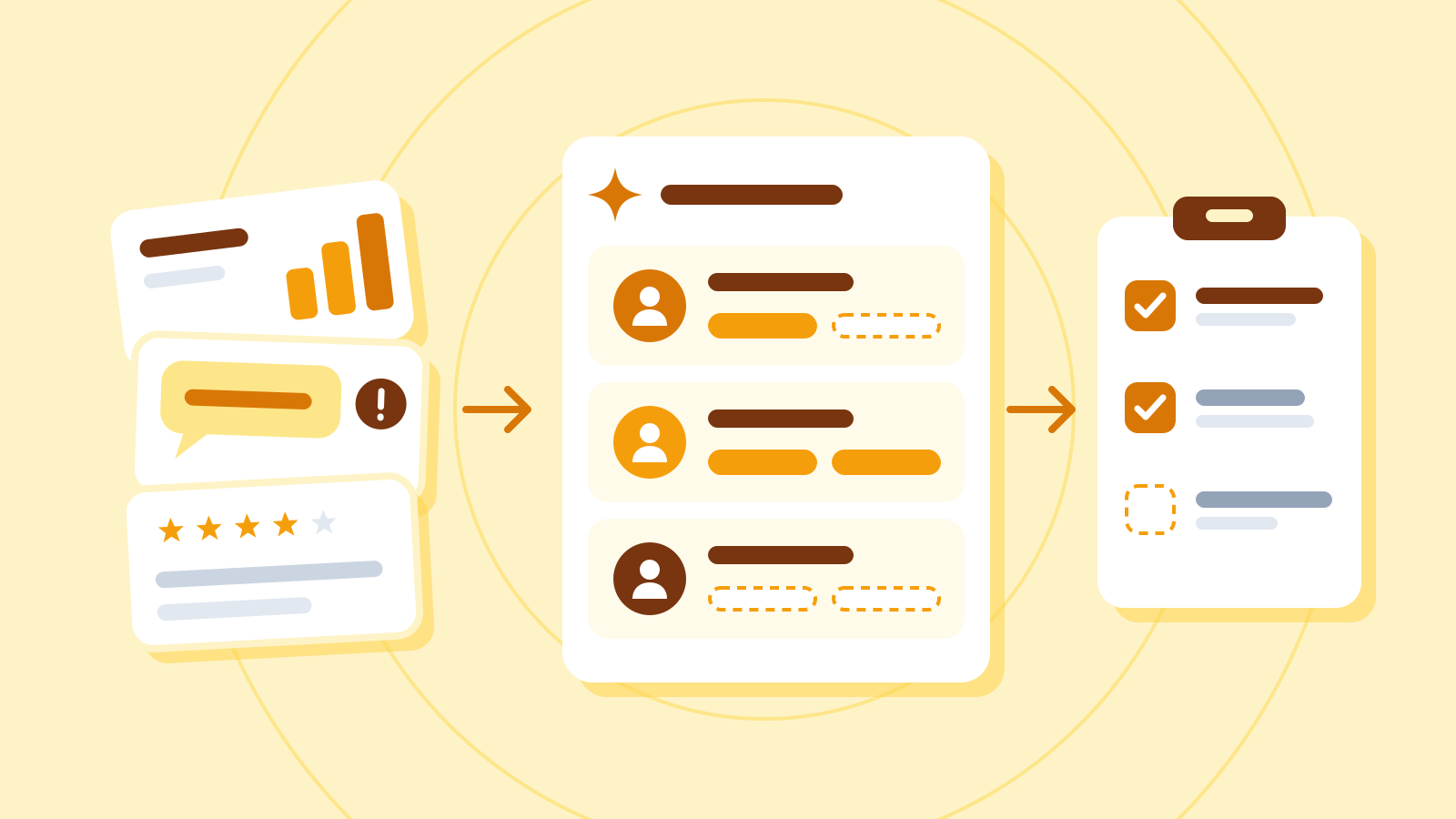
Data that can back up a persona Source What it tells you Watch out for App or shop reviews Customers' own words; what they like and dislike Only some customers write reviews, so they don't speak for everyone Support tickets Where people get stuck and what gets in the way Mostly from people who ran into a problem Survey answers Reasons and priorities you can count Question wording and answer options change the answers Sales and usage data What people actually do — when, how often, what Shows what people did, not why Colleagues who talk to customers (support, sales) Frequent questions and the mood on the front line Their impressions are opinions — treat them as assumptions
2 / 4
Step-by-step use
Learn what to prepare, how to request help and how to revise the result through examples and explanations.
Ask for personas with an evidence column
Paste in your data summary and ask the assistant to note which numbers each persona rests on. With an evidence column, you can see straight away what to trust and what to check.
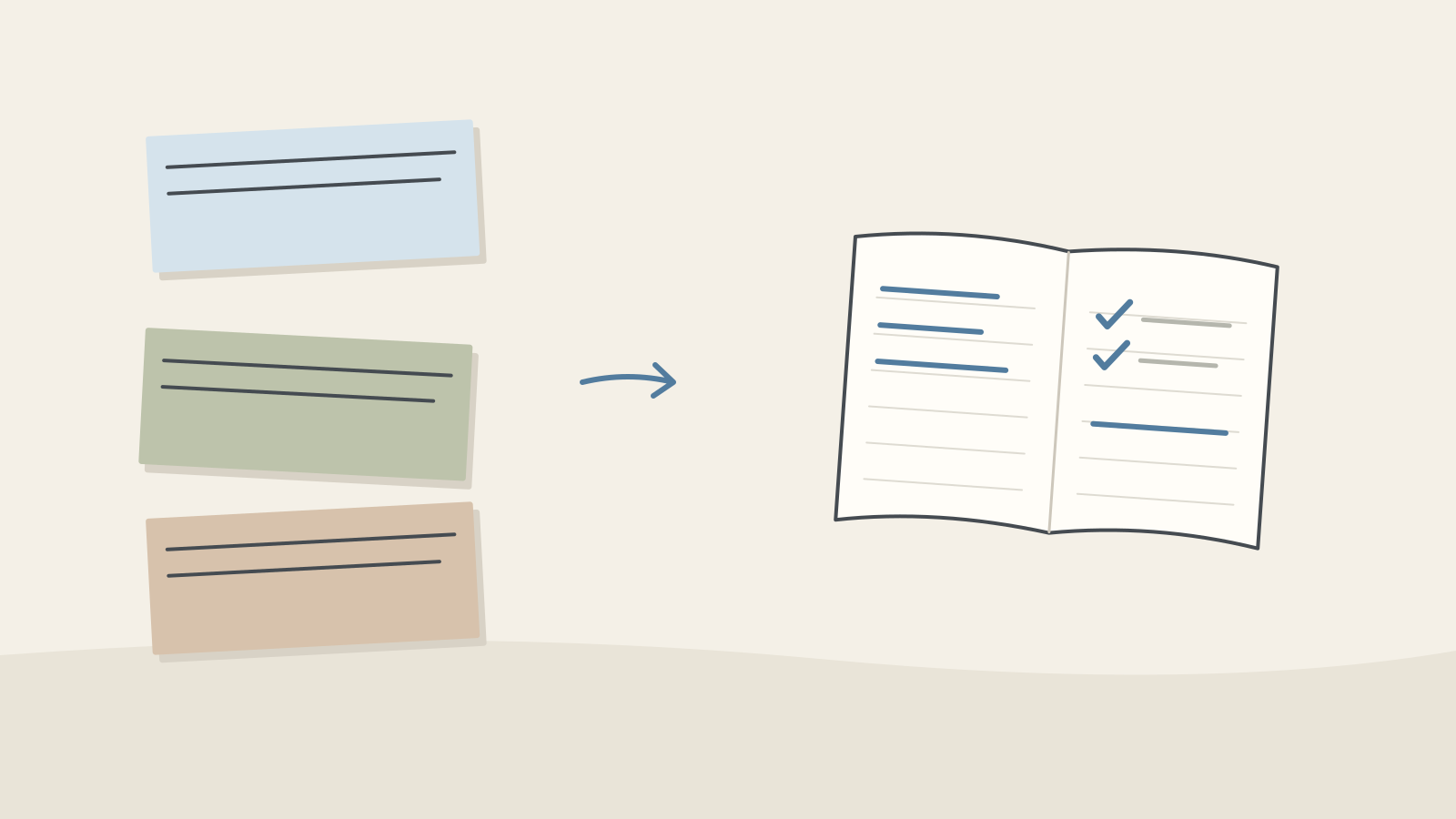
Figure: Three source collections remain distinguished in one research notebook · AI Ping This course uses a fictional ten-minute reading-log app. All numbers and names are invented. The table is a set of hypotheses built from the supplied aggregates, not validated customer types.
Example prompt We run a 10-minute reading-log app for busy professionals. Here's a summary of the last three months, with personal data removed. - 120 app reviews (mentions per topic; a review can mention several): "before work / in the morning" 46, "too tired after work" 31, "worried about finding a place to read" 18 - Of 80 support tickets: adjusting the amount to read 24, changing reminder times 16 - Free-trial survey, 200 people, biggest reason for putting off reading: no time 92, too tired 54, hard to stay motivated alone 38, other 16 - Ages of 300 new subscribers: 20s 72, 30s 141, 40 and over 87 Create three customer personas from this data as a table with the columns name, situation, goal, obstacle and evidence. In the evidence column, give the numbers from the data above that you used.
Worked example & explanation These are three editorial hypotheses for review. Each number is an aggregate from its own source; none establishes that the traits coexist in one person. Percentages are rounded.
Editorial persona hypotheses Name Situation Goal Obstacle Evidence Early-bird Jake In their 30s, office job, reads before work Read every day, even briefly No time; likes to sleep in Reviews "morning" 46 (38%); survey "no time" 92 (46%); subscribers in their 30s 141 (47%) After-work Sarah Worn out after work; short reading sessions in the evening Keep going without overdoing it Fatigue; a reading target that feels too long Reviews "tired" 31 (26%); survey "too tired" 54 (27%); tickets "reading length" 24 (30%) Quiet Mark Hypothesis: reads in a shared living space Find a short focused reading period Suitable space and difficulty maintaining the habit alone Reviews "space" 18 (15%); survey "alone" 38 (19%) Check it
- Match every number in the evidence column against your summary. A number that isn't in your summary was made up. Work out the percentages yourself too (46 ÷ 120 ≈ 38%).
- Note which persona has the thinnest evidence. Mark rests on just two numbers, and there's no telling whether those two (reviews and survey) come from the same people.
Separate evidence from assumptions
Assistants fill gaps with details that aren't in your data, and those details read naturally. Asking for a label on every detail shows at a glance what needs checking.
The easiest assumption to miss is the one that puts all the numbers into one person. The reviews, survey and sales data were collected separately, so these numbers alone can't tell you whether the morning readers are actually in their 30s.
Example prompt Break persona 1, "Early-bird Jake", into its details. Start each one with [Data] if the data I gave you supports it, or [Assumption] if not. For [Data], give the supporting number; for [Assumption], add one line on how it could be checked.
Worked example & explanation [Aggregate fact] 141 of 300 payment records (47%) concern people in their thirties. This does not establish the age of the hypothetical persona.
[Data] Reads before work, in the morning — mentioned in 46 of 120 reviews (38%).
[Data] No time — 92 of 200 survey respondents (46%) named it as the biggest reason.
[Assumption] Has an office job — only guessed from "before work". Add a question about work to the survey.
[Assumption] Wants to read every day, even briefly — no data asks about goals. Check in interviews.
[Assumption] Likes to sleep in — not in the data. Check in interviews.
[Assumption] All of the above describe the same people — the three numbers come from separate data sets. Count the ages of users who read in the morning.
Check it
- If more than half the details are assumptions, the persona is still a hypothesis. Four of Jake's seven details are assumptions, so test them in the next step before the persona shapes any ads or plans.
- If the assistant labels something [Data] but the number isn't in your summary, change it to [Assumption].
Plan how to test each assumption
For each assumption, decide how you'll check it and what result would confirm it — before you look. Set the bar afterwards and it's easy to read the results the way you hoped.
Use a survey item or a data query for things you can count, and interviews for reasons and circumstances. In interviews, avoid leading questions like "Mornings are hard, aren't they?" Ask open questions about things that actually happened.
A plan to test Early-bird Jake's assumptions (example) Assumption How to check Keep it if Has an office job Survey item: "What do you mainly do on weekdays during the day?" (office or company job, self-employed, studying, caring for family, other) "Office or company job" is the most common answer Wants to read every day, even briefly Interview: ask what they hoped for on the day they downloaded the app Several people bring up "every day" or "keeping it up" without being asked Likes to sleep in Interview: on a day they missed a reading session, ask what happened that morning Several people bring up sleep or getting up before you ask All of the above describe the same people Data query: ages of new subscribers who mostly read between 6 and 9 a.m. The share in their 30s is clearly above 47%, the figure for all new subscribers Example prompt Write five interview questions to test these two assumptions. Assumption 1: They want to read every day, even briefly. Assumption 2: Liking to sleep in gets in the way of reading. Ask open questions about things that actually happened. Leave out anything that can be answered yes or no, or that suggests an answer. Don't use the app's name or the word "sleep".
Worked example & explanation Rather than asking about either assumption directly, these questions get people talking about things that happened recently.
1. Think of the last day you read. When, where and for how long?
2. On the day you downloaded the reading-log app you use now, what were you hoping for?
3. If there was a day you meant to read but didn't, tell me what happened that day.
4. Think of your most recent weekday morning. Walk me through what you did from the moment you got up until you left home.
5. Tell me about one thing that has helped you keep reading and one thing that has got in the way.
Check it
- Read each question aloud. If it can be answered with a plain yes or no, rewrite it.
- Try the interview on a colleague first and fix any confusing questions. Tell participants what you'll record and how you'll use it, and get their consent.
Brief your ad copy with the checked persona
For a hypothetical follow-up, suppose 58 of 90 morning users are in their thirties. These are also invented data. The cross-tab connects age and time of use, not occupation or a sleep-related barrier. Promote only the specific claim supported by the new evidence.
Put the finished persona in the audience line of the brief from "Draft A/B ad copy with AI". Keep anything still being checked out of the centre of the copy.
Example prompt Product: a 10-minute reading-log app for busy professionals Audience: people in their 30s who read before work (58 of 90 new subscribers who mostly read between 6 and 9 a.m. are in their 30s) Evidence: 46 of 120 reviews mention reading before work or in the morning; 92 of 200 survey respondents put off reading because they have no time Unconfirmed assumption (don't build a headline around it): they like to sleep in Channel: Instagram feed ad Goal: sign-ups for a 7-day free trial Write two headlines, each with one line on the evidence it relies on.
Worked example & explanation 1) “Start a ten-minute reading timer before work” — an editorial draft connecting the morning-use hypothesis with the timer feature.
2) “Keep a note of what you read” — a feature description without a promised habit or outcome.
Check it
- Make sure neither headline leans on the unconfirmed assumption (sleeping in).
- An A/B test tells you which line drew more response, not that the persona is right. Recheck the persona against fresh data every quarter.
3 / 4
Check & explain
Think about what you would ask AI, then read the explanation. Written submissions and external AI use are optional.
This is a learning check, not a test you must pass. Use the explanations to understand the ideas.
Q1Morning is common in reviews and thirties are common in payments. Does this establish that morning users are mostly in their thirties?
Write your thoughts (optional)
Your writing is not sent anywhere. It disappears when you leave or reload this page, so copy anything you want to keep.
Read the answer and explanation
No. Separate aggregates do not establish a joint relationship. You need both variables on the same appropriate analysis unit. These are fictional practice data.
This is your own review, not an automatic score.
Q2Make “You cannot read because you oversleep, right?” less leading.
Write your thoughts (optional)
Your writing is not sent anywhere. It disappears when you leave or reload this page, so copy anything you want to keep.
Read the answer and explanation
Ask: “What happened the last time you planned to read but did not?” Avoid supplying the cause so unexpected explanations remain possible.
This is your own review, not an automatic score.
Q3A fictional cross-tab finds 58 of 90 morning readers in their thirties. Has their occupation also been verified?
Write your thoughts (optional)
Your writing is not sent anywhere. It disappears when you leave or reload this page, so copy anything you want to keep.
Read the answer and explanation
No. The cross-tab supports only the time–age association. Occupation and motivation require other evidence.
This is your own review, not an automatic score.
Common mistakes
- Asking for "personas for our customers" with no data, then using the result as is
- Pasting raw reviews or support tickets with names and contact details still attached
- Spending ad budget on assumptions you haven't tested
Your learning record
Completion is optional. Mark this lesson when you feel ready, or move to the next lesson without marking it.
Completion is saved in this browser.
4 / 4
Apply to your work
Consider how new material changes the workflow and checking criteria. Trying an external AI tool is optional.
Try it: leave a question instead of inventing a life story
Underline invented biography details in the first persona. “An ambitious, busy office worker” may sound convincing, but the table does not establish it. Replace decoration with a question such as whether morning readers want shorter passages.
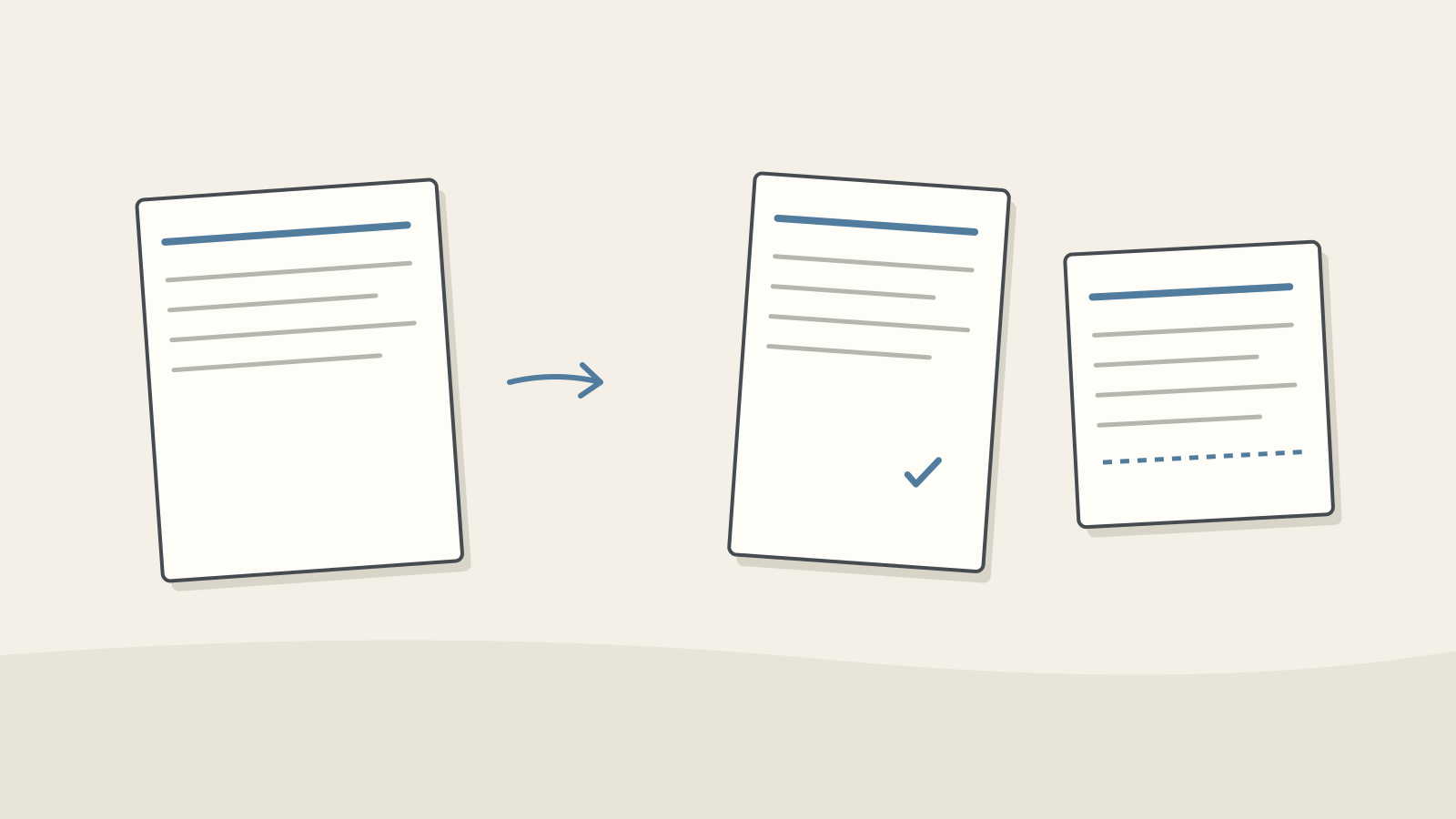
Figure: Supported notes and open questions are kept in separate groups · AI Ping Record how contradictory evidence would change the hypothesis. If choosing a book turns out to be a larger barrier than time, consider that finding rather than forcing a time-saving message. Do not present this hypothetical finding as completed research.
Keep three hypotheses, their evidence, unknowns and research questions. Carry established product facts separately from messages still to test into the copy lesson.
Write a note (optional)
Use this only if you want to record a prompt or your understanding. This is a notebook, not a connected AI assistant.
Your writing is not sent anywhere. It disappears when you leave or reload this page, so copy anything you want to keep.
References
- Learning about users and their needs — GOV.UK Service Manual
- Using in-depth interviews — GOV.UK Service Manual