When researchers disagree: revise interview coding rules with AI
Compare competing labels with verbatim evidence, revise the coding rules and use unseen interviews to check them. Keep counterexamples and uncertain statements visible.
24 min readAs of Nov 2026
Lesson guide · goals & preparation
By the end of this lesson
- Distinguish an utterance, its assigned label and an open question.
- Test revised definitions against fresh excerpts and explain holds.

Who this is for
- People grouping experiences described in interviews or reviews
What you need
- Read the fictional interview excerpts below. No analysis software is needed.
1 / 4
Theory
Understand what to ask AI to do, how to ask, and the ideas behind the workflow.
Why are there two labels next to one quote?
A participant says, “I saw Share immediately, but stopped because I thought it might send to everyone.” One researcher labels this a finding problem. Another labels it uncertainty about the outcome. Those readings would lead to different design questions.
A code is a short label used to find comparable experiences again. Preserve what the participant actually said alongside the researcher’s interpretation.
Your output is an evidence table, not a redesign. Keep the quote, candidate label, supporting words and next question together. You will test the rule a second time with excerpts that were not used to write it.
Distinguish excerpt IDs from participant IDs
I1 and I3 belong to U1. Two excerpts are not two participants. An estimate of prevalence would first need a clear denominator and a definition of what counts. This exercise does not need a percentage.
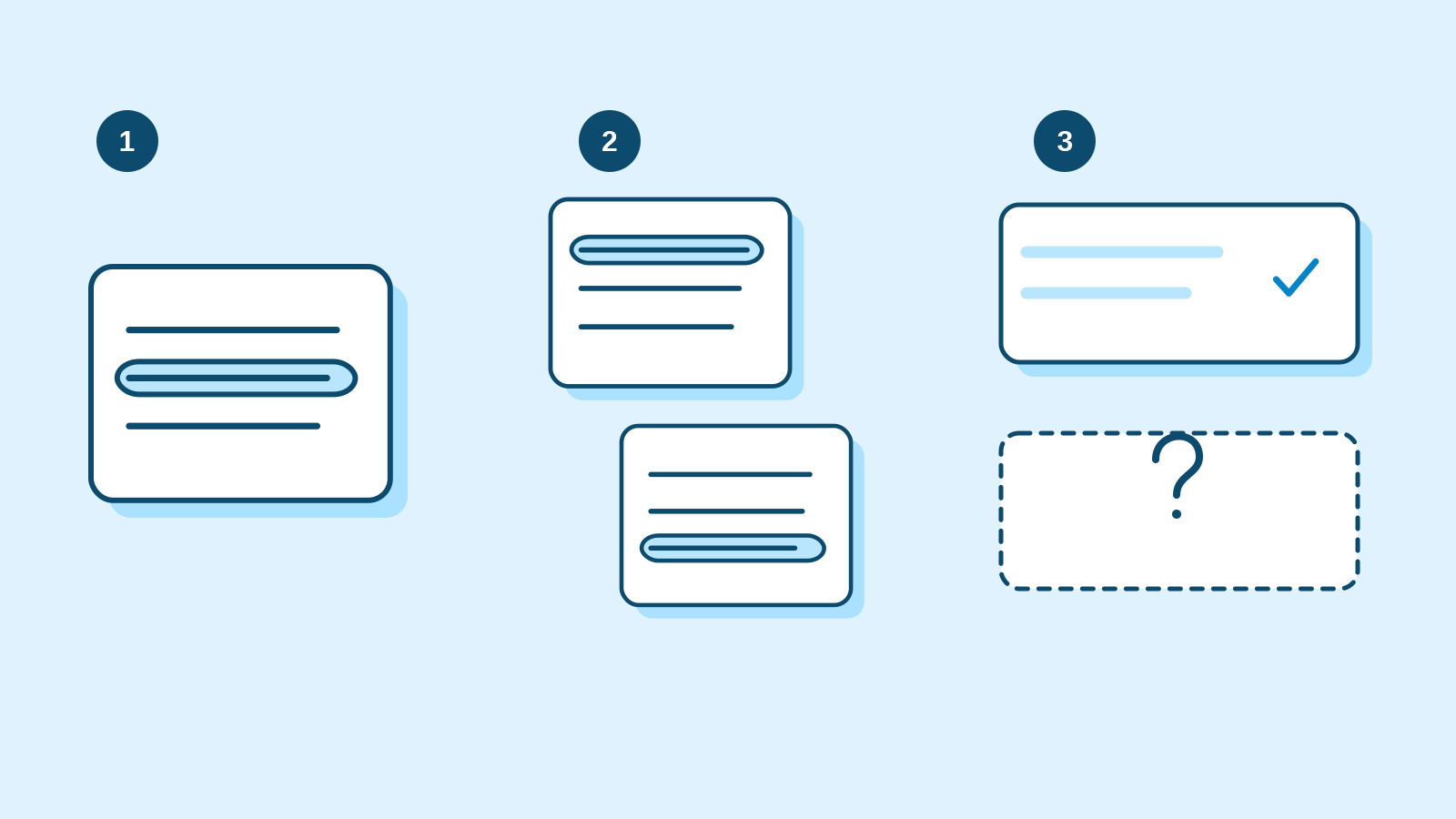
Illustration: One quotation is compared with two proposed labels and its supporting words are retained · AI Ping
- Two researchers assigned location and effect to the same I1 excerpt.
- Read “saw Share immediately” and “might send to everyone” against both interpretations.
- Code I1 as concern about the effect. I4 gives no reason and stays on hold.
Read every step as text
- The draft under review says three people could not see the button and drops I3. For I1, researcher A wrote “location” and researcher B wrote “effect”. Go back to the words themselves, one excerpt at a time.
- I1 begins “I saw Share immediately”. That contradicts the reading that the button was hard to find. The phrase is not coded; it is the evidence that rules out “location”.
- The reason for stopping comes later in the sentence. “It might send to everyone” is a worry about what the button does, so I1 is coded “effect”. Nothing says the file actually went to everyone.
- I2 describes a search: “I opened two menus before I found Share.” Both researchers coded it “location”, and it stays there under the v2 rules.
- I3, “sent it straight away”, is U1’s next attempt. The draft deleted it. It stays as “smooth”, a counterexample to any claim that U1 always struggles. Two excerpts, still one person.
- I4 only says “I just closed it.” No reason is given, so it goes on hold with a neutral question: what happened just before you closed it?
- “Three people who could not see the button” has shrunk to one location excerpt. All four excerpts are still in the table, and I1 and I3 remain separate rows that share U1.
A and B are provisional readings by two researchers. Keep the later interviews out of this first comparison. A rule written after seeing every example has not yet been tried on fresh material.
Look for evidence of searching, such as “looked through two menus”, or uncertainty about an effect, such as “might send to everyone”. “I stopped” alone tells you an outcome but not why it happened.
Fictional interviews about sharing · development set Excerpt · person Verbatim excerpt Researcher A / B I1 · U1 I saw Share immediately, but stopped because I thought it might send to everyone. Location / effect I2 · U2 I opened two menus before I found Share. Location / location I3 · U1 Next time I checked the audience and sent it straight away. Smooth / smooth I4 · U3 I just closed it that time. Effect / hold
2 / 4
Step by step
Learn what to prepare, how to request help and how to revise the result through examples and explanations.
Ask for the disagreement before asking for a decision
Retain both labels before choosing either. Request matching and conflicting rows, excerpt and participant IDs, and verbatim support for each reading.
In I1, “saw Share immediately” weighs against a finding problem. Quoting only “stopped” would hide that evidence. Read the context on both sides of a selected phrase.
I3 records a smooth experience by the same person. It is a counterexample to “U1 always struggles to share”. Keep it even when the report is about problems.
Example prompt For I1–I4 mark where A and B agree or differ. Return excerpt and participant IDs, both labels, exact evidence, contradictory evidence and any open question. Do not infer motives or estimate prevalence. Source records I1 · U1 | I saw Share immediately, but stopped because I thought it might send to everyone. | Location / effect I2 · U2 | I opened two menus before I found Share. | Location / location I3 · U1 | Next time I checked the audience and sent it straight away. | Smooth / smooth I4 · U3 | I just closed it that time. | Effect / hold
Give each code an inclusion and exclusion rule
Review this editor-written faulty draft: “I1, I2 and I4 were three people unable to see the button. Exclude I3.” Point to the visible button in I1, the missing reason in I4 and the contrary experience in I3.
Write an inclusion rule for location (explicit search), effect (uncertain consequence after finding the control), smooth (explicit easy completion) and hold (insufficient evidence). Define each before opening the new interviews.
If one excerpt describes two successive experiences, keep both spans under one ID. A finding problem and an uncertainty about the audience can coexist without creating a second participant.
Example prompt Recheck “three people could not see it” against the source. Define location, effect, smooth and hold, then recode I1–I4. Keep I3 as contrary evidence. Ask one neutral question for I4. Split distinct experiences by quote span under the same participant ID.
Read each revised label back against the source
I1 supports a concern about sending to everyone. It does not establish that the system actually shared the file that way. Keep the participant’s expectation separate from a claim about product behaviour.

Illustration: A research notebook keeps a contrasting experience and an unanswered question beside supported excerpts · AI Ping I2 supports a search problem, but not a particular confusing menu name. For I4, “What happened just before you closed it?” leaves room for an explanation. “Was the button hidden?” supplies an answer.
Check all four excerpts against the transcript. Merging U1’s two records into “eventually succeeded” would erase the earlier concern. Keep their common participant ID and separate experience rows.
Editor’s worked table · rule set v2 Excerpt Code Evidence and reading I1 · U1 Effect “it might send to everyone” expresses a feared consequence I2 · U2 Location “opened two menus before I found Share” describes a search I3 · U1 Smooth · counterexample “sent it straight away” refers to the same person’s next attempt I4 · U3 Hold “just closed it” gives no reason. What happened just before you closed it?
3 / 4
Self-check
Think about what you would ask AI, then read the explanation. Written submissions and external AI use are optional.
This is a learning check, not a test you must pass. Use the explanations to understand the ideas.
Q1Which phrase in I1 weighs against a location issue?
Write your thoughts (optional)
Your writing is not sent anywhere. It disappears when you leave or reload this page, so copy anything you want to keep.
Read the answer and explanation
“I saw Share immediately.” Read it alongside the later concern about the audience to explain why the speaker stopped.
This is your own review, not an automatic score.
Q2How would you improve “Were you worried about the audience?” for I4?
Write your thoughts (optional)
Your writing is not sent anywhere. It disappears when you leave or reload this page, so copy anything you want to keep.
Read the answer and explanation
Ask what the person was doing immediately before closing the screen. Keep the code open until there is evidence for a reason.
This is your own review, not an automatic score.
Q3How would you code J1–J3 and support the decisions?
Write your thoughts (optional)
Your writing is not sent anywhere. It disappears when you leave or reload this page, so copy anything you want to keep.
Read the answer and explanation
In J1, “searched the menus” supports location and “didn’t know who would receive it” supports effect. Both belong to U4. Hold J2 because closing has no stated reason. J3 is smooth on “sent it on the first try”. Checking the audience alone does not establish fear.
This is your own review, not an automatic score.
Common mistakes
- Inventing a reason just to eliminate a hold
- Counting excerpts as different participants
Your learning record
Completion is optional. Mark this lesson when you feel ready, or move to the next lesson without marking it.
Completion is saved in this browser.
4 / 4
Apply to your work
Consider how new material changes the workflow and checking criteria. Trying an external AI tool is optional.
Try it: apply the rules to three unseen excerpts
Apply the four definitions to each new quote without changing the rules first. Mark separate spans if the speaker describes two experiences. Supply a short quote for each decision and a reason for each hold.
Only then compare the last review answer. If a mismatch leads you to revise the definitions, these excerpts have now informed the rules. Reserve different records for the next independent check.
Unseen set · apply v2 Excerpt · person Verbatim excerpt J1 · U4 I searched the menus for Share, and once I found it I stopped because I didn’t know who would receive it. J2 · U5 I closed that screen. J3 · U6 I checked who would receive it and sent it on the first try.
Write a note (optional)
Use this only if you want to record a prompt or your understanding. This is a notebook, not a connected AI assistant.
Your writing is not sent anywhere. It disappears when you leave or reload this page, so copy anything you want to keep.
References
- Analyse a research session — GOV.UK Service Manual
- Find evidence in research notes — AI Ping