Google DeepMind launches Humanity’s First Exam to test repeat accuracy
Edited and reviewed by AI Ping Editorial Team
Key points
- The research team tested 18 models without external tools.
- The same set of answers can show the odds of finding one usable result or trusting every result.
- DeepMind is inviting submissions of everyday questions that trip up models through December 15.

Google DeepMind introduced Humanity’s First Exam on November 24 to test whether AI can reliably answer straightforward questions. Its 544 text and image prompts cover 20 basic skills. One sample asks for a count of foreground mugs without steam. For someone choosing a model to enter item counts from a series of photos, it addresses a practical question. How much does a successful first count tell you about the next photo?
Four versions form a family. GPT-6.2 Astra led the technical report at 92.4% on the chance of getting all 16 answers right across four versions and four tries apiece. The estimate for any correct answer was 100%. Gemini 4 Neon scored 85.8% for all 16 correct.
A variation can have a different correct answer. Imagine two photos of a shelf. Swap a red object with a blue one and the answer to a question about the leftmost object can change. What carries over is the operation of locating that position and reading its colour.

What five correct answers out of six can tell you
One use of repeated attempts comes from code generation. Mark Chen and colleagues used a measure called pass@k to estimate the chance that a group of candidate programs contains at least one that passes the tests. A developer who can run those tests has a way to pick a working solution.
Repeated assignments pose a different question. In τ-bench, Shunyu Yao and colleagues checked the final database state after an agent handled a retail or airline request. They measured the chance that every trial would succeed. A correct booking in one conversation cannot fix a reservation entered incorrectly in another.
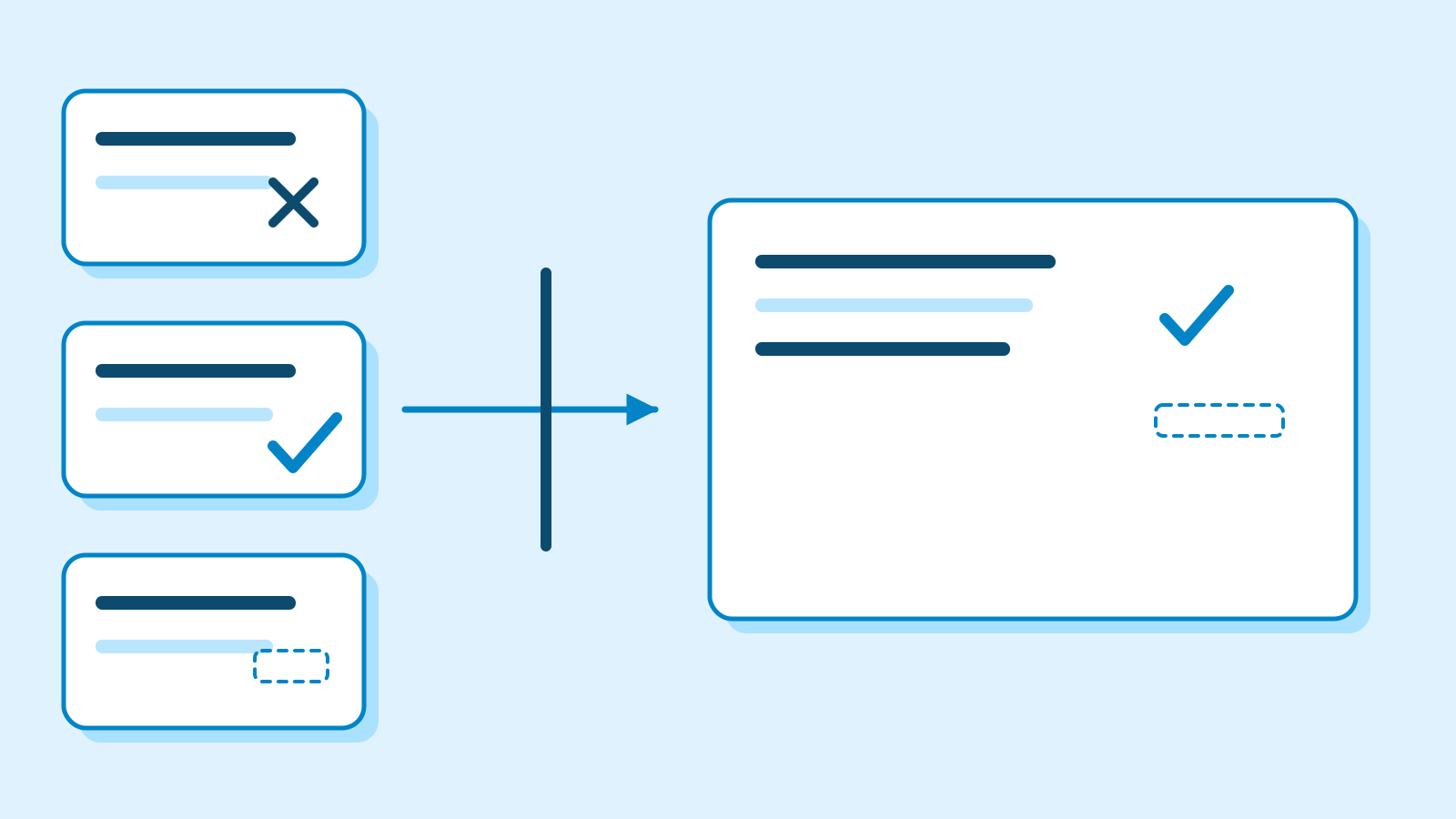
HFE sampled six independent responses per prompt and estimated the outcome of drawing four. Take a hypothetical pile of six answer sheets, five correct and one wrong. One random draw has a five-in-six chance of being correct. There are 15 ways to choose four sheets without replacement. Every selection contains a correct answer. Only five selections leave the wrong sheet in the pile. That gives 100% under the first rule and one-third under the second, with exactly the same sheets.
One example DeepMind published asks for the colour of the third letter in each word on a neon sign, in reading order. An answer can go wrong at several points. A model might start one letter too far along in the first word, read a colour incorrectly, or return the right colours in reverse order. A single score for the final sequence leaves those possibilities open.
In introducing the exam, Kaggle pointed to tasks such as naming the colours of several objects in order and checking whether something is absent from an image. On an inventory sheet, a blank field and a count of zero can mean different things. A blank leaves open whether anyone checked the shelf. Entering a zero requires checking the picture even when the question names a particular object.

An earlier study cited by DeepMind explains the choice to vary the prompts. Apple researchers working on GSM-Symbolic found that scores could shift when they changed numbers in grade-school maths questions built from the same template. The structure of a problem could stay familiar while the particular instance affected performance.
The authors deliberately selected tasks that earlier models missed. Projecting the 92.4% figure onto a hundred photos from a particular shop would change both the population and the unit being scored. The reported score describes a family of questions answered repeatedly.
The authors designated 112 prompts for release under CC BY 4.0 and held back 432 for evaluation. Under that licence, people can redistribute or adapt the public material with credit, a licence link and an indication of changes. A test built from the released material therefore covers a different set of questions from the full evaluation. DeepMind is inviting people to submit everyday questions that current models still get wrong. Its Kaggle challenge runs through December 15.
Sources
- Humanity’s First Exam and the Kaggle challenge — Google DeepMind
- Humanity’s First Exam: Measuring the Reliability Floor of LLMs — Google DeepMind, Google Cloud & Google Research
- Kaggle introduces Humanity’s First Exam — Kaggle
- Evaluating Large Language Models Trained on Code — Mark Chen and colleagues
- τ-bench: A Benchmark for Tool-Agent-User Interaction in Real-World Domains — Shunyu Yao and colleagues
- GSM-Symbolic: Understanding the Limitations of Mathematical Reasoning in Large Language Models — Apple Machine Learning Research
- Creative Commons Attribution 4.0 International — Creative Commons