Reconcile delivery slips when four arrive and only three pass inspection
Reconcile split deliveries, a duplicated slip, a damaged unit and an unassigned receipt, then update only the affected order line.
22 min readAs of Nov 2026
Lesson guide · goals & preparation
By the end of this lesson
- Distinguish a duplicated slip from a split delivery.
- Allocate a held receipt after confirmation.

Who this is for
- Anyone reconciling ordered and usable quantities.
What you need
- Know the difference between an order line and a product code.
1 / 4
Theory
Understand what to ask AI to do, how to ask, and the ideas behind the workflow.
Does arrival close a purchase order?
The carrier delivered four boxes; the inspector accepted three. Both counts can be true. In this fictional agreement only usable units assigned to an order line reduce the outstanding quantity. Keep the damaged unit visible for follow-up.
Beginners often ask whether signing the carrier's sheet means they accepted four units. The signature only confirms four boxes changed hands; it says nothing about what passed inspection. Pack both facts into one cell and the damaged box quietly joins your usable count. Keep boxes-received and units-accepted on separate lines, and you will always know which number reduces the outstanding quantity.
Read the different counts on a receipt
R4 and R5 both refer to L10 but record separate deliveries. The second occurrence of R5 explicitly says it is a copy. The slip ID identifies an event; the order-line ID tells you where to apply it. If two versions disagree on quantity, first establish which one supersedes the other.
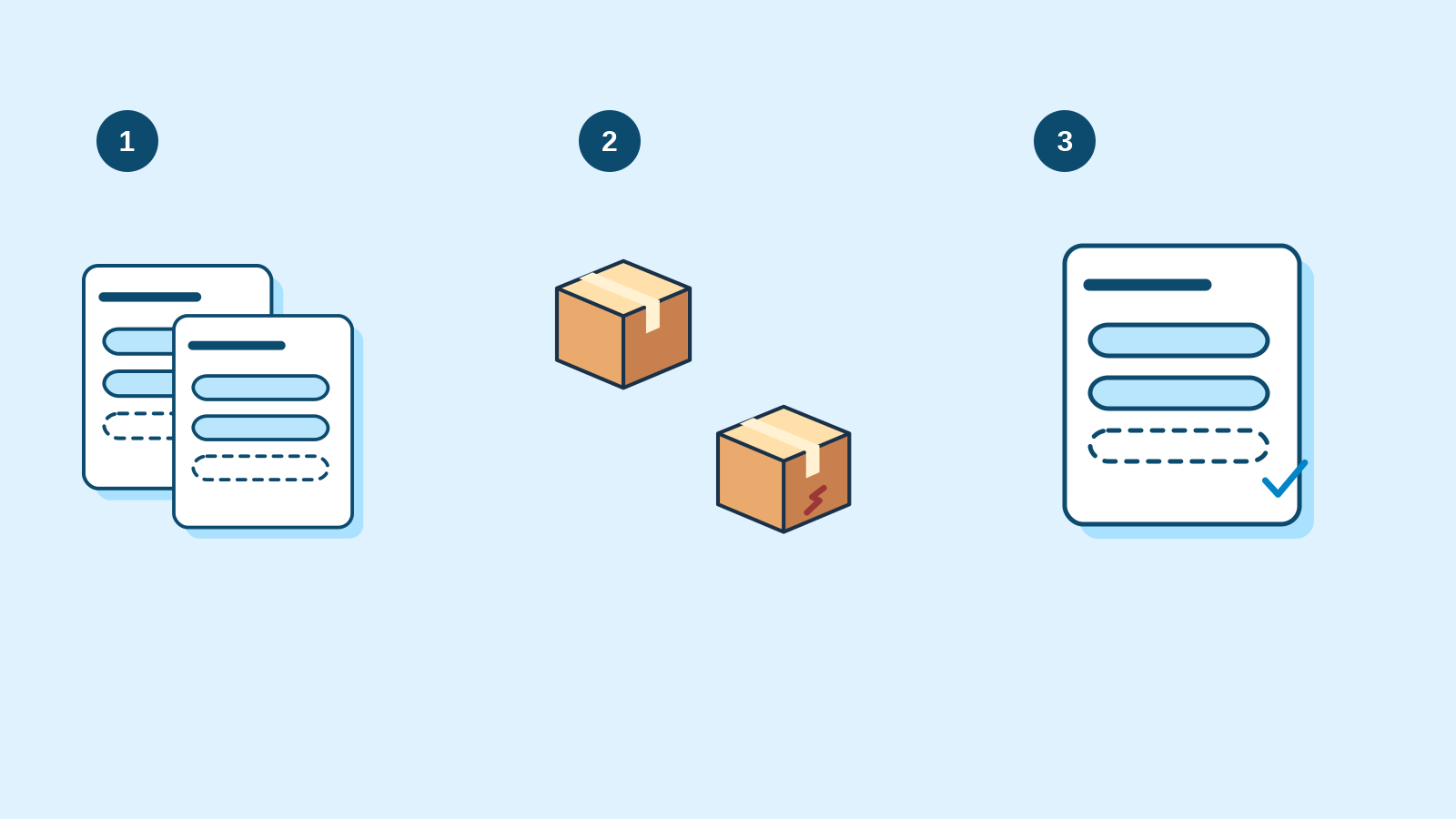
Illustration: Two copies traced to one receipt and a damaged parcel set aside · AI Ping
- R5 and its identical copy describe one inspection event.
- Three of four units passed. Allocate these to L10 and record the damage separately.
- The confirmation assigns the two held R7 units to L30, leaving three open there.
Read every step as text
- PO-18 orders 25 units. Add every accepted figure on the slips (7, 3, 3, 8, 2) and you get 23, as if only two were open. Tie each slip to an order line instead.
- R4 names L10. Its seven accepted units go to that line, leaving 18 open across the order.
- R5 is a second, separate delivery for L10. Four arrived, but only the three accepted units reduce the open quantity.
- R5’s damaged unit is recorded on its own, outside any order line. Three accepted plus one damaged matches the four that arrived.
- The R5 copy repeats the same slip number and the same values. It is one inspection event, so it adds nothing and is logged as an exclusion.
- R6’s eight accepted units go to L20, which is now complete. Seven units remain open overall.
- R7’s two folders passed inspection but name no order line. They would fill L10 exactly, yet L30 is waiting for the same folders. They are held, not assigned.
- Receiving confirms that R7 belongs to L30. The two held units are linked to that line: 20 assigned, five open.
- The confirmation is not a new delivery, so no extra slip is entered. Open units per line (2 + 0 + 3) and 25 − 20 both give five. The damage record stays.
One slip already holds three numbers. R5 reads four arrived, three accepted, one damaged. There is a check you can run by hand: add accepted to damaged and see whether it equals arrived. Three plus one is four, so the slip is internally consistent. If accepted three and damaged one sat under an arrival of five, a unit is unaccounted for—ask before summing. Request all three cells from the AI so arrivals never leak into the open quantity.
PO-18 lines and fictional inspection slips Record Target Note Order L10 / L20 / L30 12 folders / 8 notebooks / 5 folders R4 L10 7 arrived, 7 accepted R5 L10 4 arrived, 3 accepted, 1 damaged R5 copy L10 4 arrived, 3 accepted, 1 damaged R6 L20 8 arrived, 8 accepted R7 F-04 folder 2 accepted, no order line
2 / 4
Step by step
Learn what to prepare, how to request help and how to revise the result through examples and explanations.
Specify which events can enter the sum
Ask for accepted, damaged and unassigned stock separately. Open quantity equals ordered units minus accepted units allocated to that line. Record the excluded copy as an exclusion so the next clerk can see why it contributes nothing.
Here is a way to audit the table the AI returns. You fed five rows: R4, R5, the R5 copy, R6 and R7. Walk down the evidence column and count how often each slip is cited. R4 and R5 appear once each, the copy appears once as an exclusion, R6 once, R7 once as held. If any slip is added twice or has vanished, ask again even when the totals look tidy.
Example prompt Count each receipt event once. Return ordered, assigned accepted, open and source per line. List damage and unassigned accepted stock separately. Explain each excluded copy. PO-18 lines and fictional inspection slips Record | Target | Note Order | L10 / L20 / L30 | 12 folders / 8 notebooks / 5 folders R4 | L10 | 7 arrived, 7 accepted R5 | L10 | 4 arrived, 3 accepted, 1 damaged R5 copy | L10 | 4 arrived, 3 accepted, 1 damaged R6 | L20 | 8 arrived, 8 accepted R7 | F-04 folder | 2 accepted, no order line
Keep two unassigned units visible
An editor wrote “L10 is complete with twelve folders” as a test draft. Only seven from R4 and three from R5 identify L10. The two on R7 would fill the gap exactly, but L30 also needs the same folders. Ask which PO-18 line R7 belongs to.
If the held tray only says “unassigned 2,” nobody will recall what those two were a week later. Write the slip number R7, note that the item is folders, record two accepted, and name both candidate lines, L10 and L30. Add the date. Then, when receiving answers, you need not hunt for which R7 you meant. A number that fills a gap perfectly still has not proved its own source, and the note remembers that for you.
Example prompt Trace the receipts that closed L10. Move R7 to unassigned, recalculate L10 and L30 and write one question for receiving.
Worked example & explanation Before confirmation L10 is open by 2, L20 by 0 and L30 by 5. Show R7’s two accepted units separately and retain the damage record.
Post a confirmation to exactly one line
The receiving desk confirms R7 belongs to L30. Apply the existing slip to that row rather than entering another receipt. Allocated units rise from 18 to 20 and open units fall from seven to five; physical accepted stock was already twenty before the message.
Illustration: A held receipt linked to a single line after confirmation · AI Ping After editing one line, add the table in two directions. Sum the per-line open figures: two plus zero plus three is five. Then subtract allocated twenty from ordered twenty-five, which is also five. When the two results match, you changed one cell without disturbing another. If the line-by-line sum were six while the subtraction gave five, one open figure is wrong—revisit only the changed cells. Keep doing both additions even when the AI rebuilds the whole table.
After R7 is assigned to L30 Line Ordered Accepted and assigned Open Evidence L10 12 10 2 R4 7 + R5 3 L20 8 8 0 R6 L30 5 2 3 R7 + confirmation Total 25 20 5 One damaged unit tracked separately
3 / 4
Self-check
Think about what you would ask AI, then read the explanation. Written submissions and external AI use are optional.
This is a learning check, not a test you must pass. Use the explanations to understand the ideas.
Q1How much is open before confirmation?
Write your thoughts (optional)
Your writing is not sent anywhere. It disappears when you leave or reload this page, so copy anything you want to keep.
Read the answer and explanation
In this teaching order A has 5 open and B has 1. Hold S3’s two boxes outside either line.
This is your own review, not an automatic score.
Q2Report allocated units and damage after the note.
Write your thoughts (optional)
Your writing is not sent anywhere. It disappears when you leave or reload this page, so copy anything you want to keep.
Read the answer and explanation
A has 6 allocated and 3 open. B has 3 allocated and 1 open. No accepted units are unassigned; one damaged box still needs follow-up.
This is your own review, not an automatic score.
Q3What if the resent S1 said five accepted?
Write your thoughts (optional)
Your writing is not sent anywhere. It disappears when you leave or reload this page, so copy anything you want to keep.
Read the answer and explanation
The two versions conflict. Ask the inspector which is authoritative before applying an adjustment.
This is your own review, not an automatic score.
Common mistakes
- Subtracting arrivals treats a damaged unit as usable.
- A matching product code alone cannot allocate an unidentified slip.
Your learning record
Completion is optional. Mark this lesson when you feel ready, or move to the next lesson without marking it.
Completion is saved in this browser.
4 / 4
Apply to your work
Consider how new material changes the workflow and checking criteria. Trying an external AI tool is optional.
Try a fresh batch of split deliveries
Try the pencil order below twice. First put the two unidentified boxes aside and record the duplicate. Then apply the final confirmation and circle only the changed cells. Deliver a sentence covering open quantities and the damaged item as well as your table.
Cover the final confirmation with paper. In the first register distinguish stock with a known destination from unallocated units. Then uncover the note and record only the differences. A receipt can be held in one snapshot and assigned in the next. Check that it never occupies both buckets in the same snapshot.
A fresh order and its slips Record Contents Order A: 9 pencil boxes, B: 4 pencil boxes S1 / A 5 received, 4 accepted, 1 damaged S1 copy / A Same slip resent S2 / B 3 accepted S3 / no line 2 pencil boxes accepted Confirmation Assign S3 to A
Write a note (optional)
Use this only if you want to record a prompt or your understanding. This is a notebook, not a connected AI assistant.
Your writing is not sent anywhere. It disappears when you leave or reload this page, so copy anything you want to keep.
References
- Use AI to reconcile monthly reports across CSVs — AI Ping
- SUMIFS — Google